Celebrating Outstanding Global Impact in AI!
We are thrilled to announce the winners of the Global Swiss AI Award 2025, honored this January in Davos for their groundbreaking contributions to the field of artificial intelligence. This year, the jury has selected a laureate who has democratized creativity through generative vision, alongside a special recognition for a team setting new standards in open and multilingual AI.
Björn Ommer – Winner, Global Swiss AI Award 2025
Prof. Dr. Björn Ommer has been awarded the Global Swiss AI Award 2025 for advances that have reshaped what is technically and socially possible in image generation. Leading the Computer Vision & Learning Group at LMU Munich, he and his team delivered one of the decisive conceptual breakthroughs of modern AI: Latent Diffusion Models.
This innovation provided the key insight that image generation could operate in a compressed "latent" space rather than pixel-by-pixel, dramatically reducing computational costs while preserving quality. This research led directly to Stable Diffusion, a tool that transformed a high-level innovation into an accessible, open technology used by creatives, researchers, and media professionals globally. The jury honors Prof. Ommer not only for this technical milestone but for shaping a more open, democratic, and human-centered trajectory for artificial intelligence.
Team Apertus – Special Recognition Award
The jury has also bestowed a Special Recognition Award upon Team Apertus, represented by Dr. Imanol Schlag, for delivering a breakthrough in open, transparent, and multilingual generative AI.
Developed within the Swiss AI Initiative (involving EPFL, ETH Zurich, and CSCS), Apertus is a foundation model trained on 15 trillion tokens across over 1,000 languages. It represents a clear statement that frontier AI can be built with scientific rigor and public accountability. By releasing the model with openly available architecture, weights, and training methodology, Team Apertus and Dr. Schlag have set a new global benchmark for reproducibility and trust, ensuring that powerful AI remains a sovereign and globally useful public good.
'Prof. Dr. Björn Ommer and his team have delivered one of the decisive conceptual breakthroughs of modern AI: the “Latent Diffusion Models” introduced in 2022. This work provided the key insight that image generation does not need to operate directly on every pixel, but can instead work in a strongly compressed latent space, reducing computational cost dramatically while preserving image quality to a remarkable degree.'


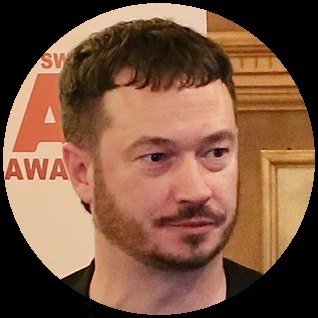
Award Ceremony in Davos during the WEF 2025
Prof. Dr. Thilo Stadelmann (Director CAI, ZHAW)
Prof. Dr. Benjamin Grewe (Institute of Neuroinformatics, ETH Zurich)
Pascal Kaufmann (president Mindfire Foundation)
Jakob Uszkoreit (Co-Founder & CEO Inceptive)
Valérie Favre Accola (Vice Mayor of Davos)

In 2024, the Global Swiss AI Award was presented to the authors of the seminal research paper "Attention Is All You Need," represented in Davos by Jakob Uszkoreit. This visionary team - including Ashish Vaswani, Noam Shazeer, Niki Parmar, Llion Jones, Aidan N. Gomez, Lukasz Kaiser, and Illia Polosukhin - redefined the landscape of artificial intelligence with the introduction of the Transformer architecture.
Their work became the foundation for the modern era of Generative AI, powering major systems such as GPT, BERT, and countless others. By enabling models to process data with unprecedented efficiency and context, their contribution spans far beyond Natural Language Processing (NLP), driving breakthroughs in computer vision, biology, and beyond. This award honors a monumental achievement that continues to inspire engineers worldwide and serves as the bedrock for the AI capabilities we see today.

Yann LeCun, a pioneer in artificial intelligence (AI), is a highly renowned computer scientist celebrated for his groundbreaking contributions. Born in Paris in 1960, LeCun is characterized by an inexhaustible curiosity and passion for understanding intelligence. With an exceptional academic background and a PhD from the University of Paris, he started a career that would profoundly impact the global AI landscape. Known for his approachable personality and collaborative spirit, LeCun has inspired countless researchers and students, earning respect for his intellect and commitment to fostering a vibrant AI community. Yann LeCun's profound impact on artificial intelligence is embodied in his groundbreaking work in deep learning and neural networks. He is considered the driving force behind the development of convolutional neural networks (CNNs) and has revolutionized image recognition and pattern analysis with his research. As a Chief AI Scientist at Meta and a New York University (NYU) professor, LeCun's impact reaches beyond academia. His work extends the theoretical level and lays the foundation for practical applications across all industries. LeCun's commitment to advancing AI has made him a leading force in shaping the future of intelligent systems globally.

Demis Hassabis is an AI researcher and entrepreneur, and currently CEO at DeepMind and Isomorphic Labs and a UK Government AI Advisor. After successful academic careers and computer game development, Demis Hassabis co-founded DeepMind in2010. A child chess prodigy, he designed and programmed the multi-million-selling, award-winning game Theme Park at 17. After graduating from Cambridge University, he founded the pioneering videogames firm ElixirStudios and completed a Ph.D. in cognitive neuroscience at UCL. Demis is a Fellow of the Royal Society. In 2017 he was featured in the Time 100 list of most influential people, and in 2018 he was awarded a CBE for services to science and technology. In 2022, he won the Princess of Asturias Award for Technical and Scientific Research, and in 2023 the Breakthrough Prize in Life Sciences for developing AlphaFold.

François Chollet is a French software engineer and artificial intelligence researcher currently working at Google. Chollet is the creator of the Keras deep-learning library, released in 2015, and a main contributor to the TensorFlow machine learning framework. His research focuses on computer vision, the application of machine learning to formal reasoning, abstraction, and how to achieve greater generality in artificial intelligence. Chollet graduated with a Master of Engineering from the ENSTA Paris school in 2012 and started working at Google in 2015. His papers have been published at major conferences in the field, including the Conference on Computer Vision and Pattern Recognition(CVPR), the Conference on Neural Information Processing Systems (NeurIPS), the International Conference on Learning Representations (ICLR). Chollet is the creator of the Abstraction and Reasoning Corpus (ARC) Challenge.
The application process grounds on a scouting process, tracing and following hundreds of scientists, entrepreneurs and other leaders in the field of AI in Switzerland and beyond. Selected jury members from Business and Academia conduct video interviews, analyse patents and do a deep dive into the achievements, technology developed, complemented by interviews with researchers, customers or end users. The innovation and breakthrough potential is then assessed using a four-tier grading system by professors and researchers from Switzerland’s leading universities and institutes of higher education along the following dimensions: I. scientific impact, II. timeframe of the impact, III. novelty, IV. popularity past and future, V. sustainability.